What is petty cash? Petty cash is a small amount of money that an organisation or business keeps on hand to pay for everyday expenses such as postage, refreshments, parking, stationery or other small purchases. Every payment should be recorded, and evidence attached, so you always know how much cash you have, where it has been spent and that your records are accurate.
Although the amounts involved are usually quite small, good record keeping is just as important here as it is for larger transactions. A simple system can save time, reduce confusion and make preparing financial reports much easier.
If you’ve recently become responsible for managing it, don’t worry. It’s one of those jobs that seems more complicated than it really is. In this guide, I’ll explain how it works, why it’s important, answer some of the questions I’m asked most often and share my Free Petty Cash Record Template, which you can download and start using straight away.
Petty Cash at a Glance
Before we go any further, here’s the short version.
Petty cash is used for everyday purchases that aren’t practical to pay by bank transfer or card. It should be recorded every time money comes in or goes out, receipts should be kept wherever possible, and the amount of cash you have should always match the balance on your record.
It really is that simple.
Why do organisations use petty cash?
Most organisations have occasional purchases that need to be made quickly.
Perhaps someone needs to buy milk before a meeting, pay for parking while attending an event, collect cleaning products or pick up some stationery because the printer has run out of paper.
For purchases like these, using it is often easier than arranging a bank payment or asking someone to pay personally and claim the money back later.
The amount of cash an organisation keeps will vary. Some only keep a small float, while others may keep a larger amount depending on how often it’s used.
The important thing isn’t how much money is in the cash tin.
It’s knowing exactly where it’s gone.
One thing I’ve noticed over the years is that people rarely forget the larger purchases. It’s the smaller everyday expenses that are much easier to overlook. A few pounds here and there soon become difficult to explain if they haven’t been recorded properly.
Why good petty cash records matter
People sometimes tell me, “It’s only a few pounds.”
They’re right.
But today’s £4 parking ticket, tomorrow’s £8 stationery purchase and next week’s refreshments for a meeting soon become £50 or £100 over the course of a few months.
Without a simple record, those purchases become surprisingly difficult to remember.
Keeping accurate cash records isn’t about creating unnecessary paperwork. It’s about making life easier.
When every transaction is written down as it happens, you always know how much cash should be available. If somebody asks where the money has been spent, the answer is already there. If you’re preparing financial reports, reviewing expenditure or checking grant spending, you’re not relying on memory or searching through old receipts.
Good records save time because they prevent problems before they happen.
What is petty cash in accounting?
From an accounting point of view, petty cash is classed as a current asset because it belongs to the organisation.
Even though the balance is usually quite small, it still forms part of your financial records and should be managed in the same way as any other money.
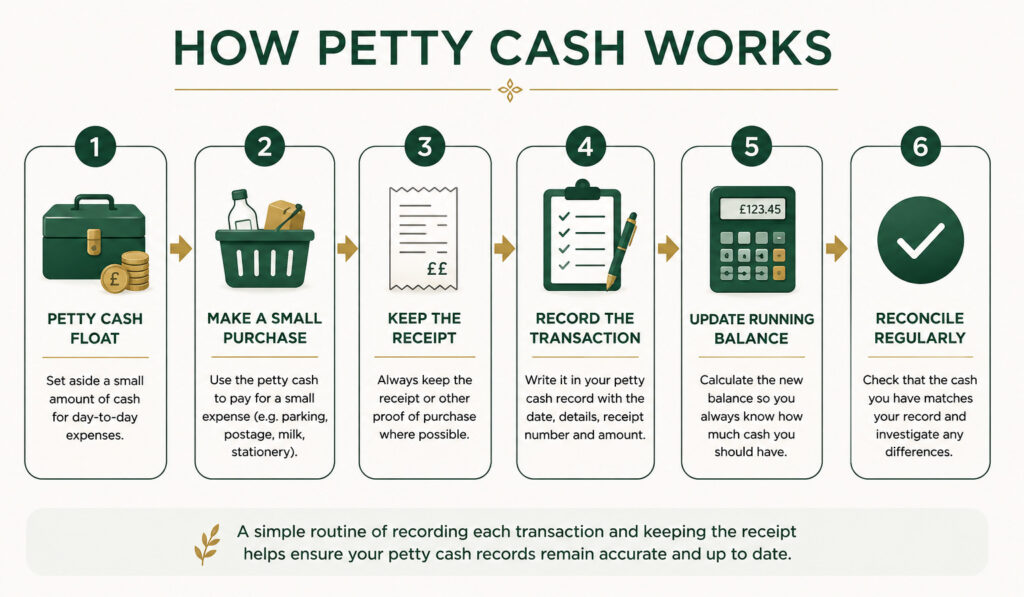
Whenever cash is paid out, or additional money is added to the float, the transaction should be recorded. Ideally, every payment should also have a receipt or another record explaining what the money was used for.
The aim is straightforward.
At any point, the amount of cash in your petty cash tin should match the balance shown on your record sheet.
If it doesn’t, it’s much easier to investigate while everything is still fresh than several weeks or months later.
What is a petty cash book?
People often ask me whether a petty cash book is different from a petty cash record.
The answer is no.
Some people call it a petty cash book, others use terms such as petty cash log, petty cash sheet or petty cash record. They’re all describing exactly the same thing.
It’s simply a record of money coming in, money going out and the balance remaining afterwards.
Good records don’t need to be complicated. In fact, I’ve found that the simpler a system is, the more likely people are to use it consistently.
That’s exactly why I created my Free Petty Cash Record Template.
The template provides space to record the date, description, receipt reference, money received, money paid out and your running balance. It’s designed to be printed and completed by hand, attaching evidence with a paperclip or staple, making it ideal for organisations that prefer a straightforward paper-based system.
Common mistakes I see
One of the advantages of working with different organisations is that you start to notice the same problems appearing time and time again.
Very rarely are those problems caused by complicated accounting.
More often they’re caused by everyday habits.
People mean to write purchases down later but get interrupted. Receipts end up in coat pockets or handbags. Someone assumes another member of the team has already recorded the transaction.
None of these mistakes are unusual.
Fortunately, they’re also easy to avoid.
The simplest approach is usually the best one. Record each purchase when it happens, keep the receipt with your records and check the balance regularly.
Those few minutes of routine record keeping can save a surprising amount of time later.
My Practical Tip
It’s much easier to spend thirty seconds recording a transaction than thirty minutes trying to remember it later.
Good financial records are built from small, consistent habits rather than complicated systems.
Download my Free Petty Cash Record Template
If you’re looking for a simple way to keep your petty cash organised, I’ve created a Free Petty Cash Record Template that you can download and start using straight away.
It’s suitable for third sector organisations, community organisations, and businesses, and has been designed to make everyday record-keeping as straightforward as possible.
The template includes space to record the transaction date, a description, receipt reference, money received, money paid out and a running balance. You can print as many copies as you need and use them whenever your petty cash is in use.
Sometimes the simplest tools are the ones that make the biggest difference.
Frequently Asked Questions
Is petty cash an asset?
Yes. Petty cash is classed as a current asset because it belongs to the organisation. Although the balance is usually small, it should still be recorded accurately and reconciled regularly.
Why is it called petty cash?
The word petty simply means small or minor. Petty cash refers to money that’s kept aside for small everyday purchases rather than larger payments.
Do I need receipts for petty cash?
Wherever possible, yes. Receipts provide evidence of expenditure and make it much easier to reconcile your petty cash if questions arise later.
How often should petty cash be checked?
That depends on how often it’s used, but checking it regularly is good practice. Many organisations reconcile their petty cash weekly or monthly, while others do it whenever the cash float is topped up. Doing it once the sheet is full at a minimum is good practice, if you find the sheet is mostly full monthly, make it a monthly habit, if you use a sheet a week, build it into your weekly routine. But by doing them whenever the sheet is full means you’re never more than 20-ish transactions, before reconciling.
Can businesses and third sector organisations use the same petty cash record?
Absolutely. The principles are exactly the same. Whether you’re managing petty cash for a business, community organisation or third sector organisation, the aim is to keep a clear and accurate record of every transaction.
Do I need accounting software to manage petty cash?
No. Many organisations manage petty cash perfectly well using a simple paper record, provided transactions are recorded consistently and receipts are kept together.
My Final Thoughts
Petty cash might seem like a small part of your finances, but it’s often a good reflection of how well your financial systems are working overall.
Simple, consistent record-keeping reduces confusion, saves time and makes it much easier to understand where money has been spent. It also gives everyone confidence that the figures are accurate.
If you’re looking for an easy place to start, download my Free Petty Cash Record Template and give it a try. Sometimes improving your financial systems doesn’t require complicated software. It just starts with having a clear, practical record that everyone can use.